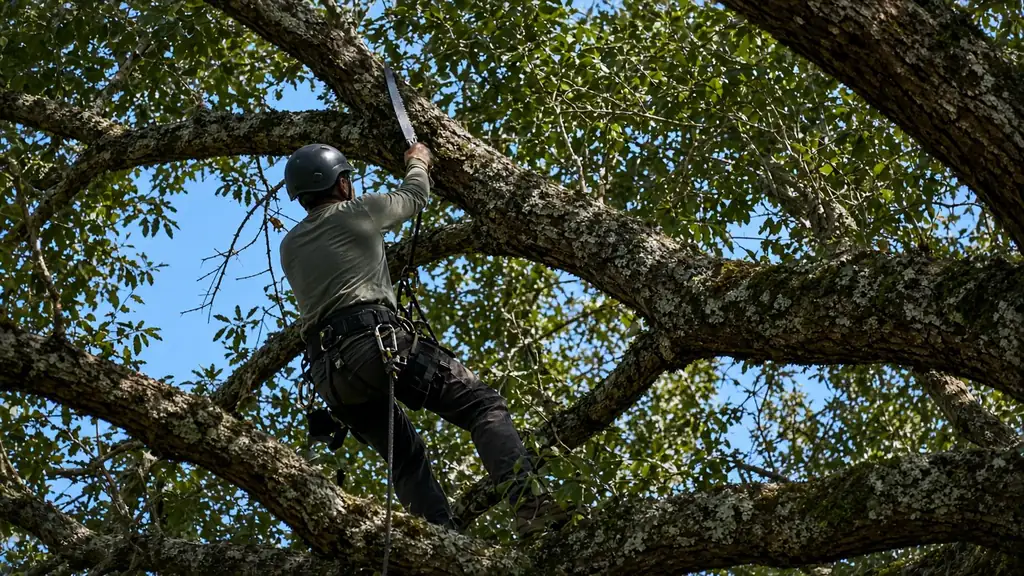
Why pruning matters on the Gulf Coast
In a place where hurricanes and tropical storms arrive regularly, how a tree is pruned has a direct effect on whether it stays standing. Research after Florida hurricanes has shown that well-structured trees with a single dominant trunk and evenly spaced limbs hold up far better than trees with multiple competing trunks or heavy, overextended limbs. Proper pruning moves trees in that direction. It also removes dead wood before it falls on a car or a person, keeps branches off roofs and gutters, and lets more light reach your lawn.
Pruning services
- Crown cleaning: removing dead, dying, broken and diseased branches throughout the canopy. This is the most common and most valuable type of pruning for mature oaks.
- Crown thinning: selectively removing some interior branches to reduce wind resistance and weight without changing the tree's natural shape. Done properly, no more than about a quarter of the living canopy is removed in one season, and usually much less.
- Crown raising: removing lower limbs to clear roofs, driveways, sidewalks and streets. Many municipalities expect clearance over sidewalks and roads.
- Weight reduction on long limbs: shortening heavy, horizontal live oak limbs back to a properly sized lateral branch to reduce the chance of failure over a house.
- Structural pruning for young trees: guiding young oaks and other shade trees toward one main trunk while they are small. This is the cheapest way to get a storm-resistant tree twenty years from now.
- Palm trimming: removing dead fronds, seed pods and old boots from sabal and other palms. We avoid over-trimming healthy green fronds, which weakens palms.
What we won't do: topping
Topping, cutting the main trunk or large limbs back to stubs, is still common, and it is one of the worst things you can do to a tree. Topped trees respond by sprouting dense clusters of weakly attached shoots that grow fast and break easily in wind. The large stub wounds decay. Within a few years the tree is more dangerous than before and needs constant maintenance. If a tree is too big for its space, the right answers are reduction pruning back to lateral branches, or in some cases removal and replanting with a better-suited species.
Following the standard
Professional pruning in the U.S. is guided by ANSI A300, the industry standard for tree care practices. In plain terms, that means cuts are made just outside the branch collar instead of flush with the trunk, no climbing spikes on trees that are being pruned (spikes wound the bark), and a clear objective for each job, such as "remove deadwood two inches and larger and clear the roof by eight feet." Ask any tree service you're considering what their pruning objective is. If the answer is just "we'll trim it back," keep asking.
Timing pruning around storm season
Atlantic hurricane season runs from June 1 to November 30, with the most activity in August, September and October. The best time to prune for storm readiness is before that, in late winter and spring. Pruning can be done any time of year in Pensacola, and urgent hazards should never wait, but scheduling routine work early avoids the rush when a storm enters the Gulf and every tree crew in town is booked. For oaks, avoiding heavy pruning during the spring growth flush is also gentler on the tree.
One caution: don't wait until a storm is a few days away and then pile limbs at the curb. Loose debris becomes projectiles in high wind, and pickup crews stop collecting before landfall. Escambia and Santa Rosa County both ask residents to avoid putting out new yard debris once a storm is approaching.
How often should trees be pruned?
For mature shade trees near your house, a professional inspection and pruning every three to five years is a reasonable rule of thumb. Young trees benefit from structural pruning every two to three years in their first decade. Fast-growing laurel oaks and trees directly over a roof may need attention more often. Pines generally need little pruning beyond deadwood removal.
Pruning costs
Pruning prices depend mostly on the size of the tree, how much work is involved and access. Light crown cleaning on a mid-size tree is far less than a full climb-and-thin on a huge live oak over a pool enclosure. See the cost guide for typical ranges, or ask for a free estimate. If a tree is too far gone to save, we'll tell you, and removal might be the better value. For a broader look before storm season, consider an arborist assessment.
Frequently asked questions
Can you trim a tree without removing it?
Yes. Most trees we work on are pruned, not removed. Our goal is to keep healthy trees healthy and safe, and to recommend removal only when a tree is dead, failing or poorly located.
Will thinning protect my tree in a hurricane?
Proper thinning and deadwood removal reduces risk, but no pruning can make a tree hurricane-proof. Over-thinning, sometimes called lion-tailing, can actually increase risk by pushing weight to branch tips.
Do you trim palm trees?
Yes. We remove dead and dying fronds, seed stalks and fruit. We recommend leaving healthy green fronds in place; heavy hurricane cuts weaken palms.