When a tree needs to come down
Not every problem tree needs to be removed. Many can be saved with pruning, and a healthy live oak is worth protecting. But some trees are past the point of saving, and in a hurricane zone, waiting is a gamble. Removal is usually the right call when you see:
- Dead or mostly dead trees. A pine that has turned brown from top to bottom is dead, and dead pines become brittle within months. Oaks that leaf out only on a few limbs are in serious decline.
- Decay in the trunk or root flare. Mushrooms or conks at the base, cavities, soft wood and carpenter ants are signs of internal rot. Laurel and water oaks are especially prone to this as they age.
- A new or worsening lean. A tree that has always leaned is often stable. One that started leaning after a storm, with soil heaving or cracking on the opposite side, is a warning sign.
- Large cracks or splits, especially where two trunks of similar size meet in a tight V.
- Lightning or beetle damage in pines. Long strips of missing bark, pitch tubes or fine sawdust in bark crevices often mean the tree will not recover.
- Trees too close to the house. A fast-growing oak planted three feet from a foundation can damage slabs, gutters and roofing as it grows.
How we remove trees safely
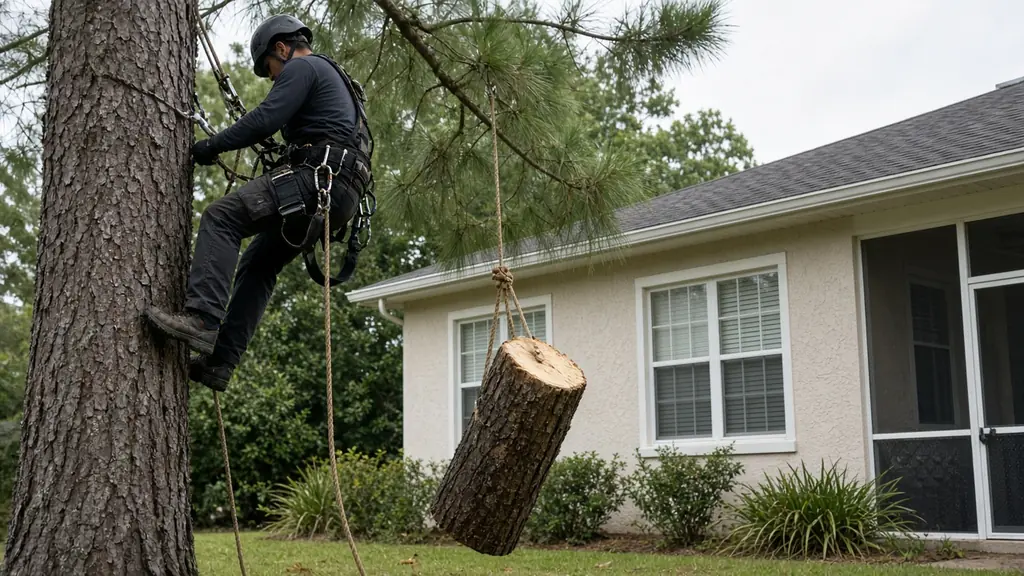
Open-yard removals, where a tree can be felled in one piece into open space, are the simplest and least expensive. Most Pensacola backyards don't allow that. Fenced lots, pools, sheds, screen enclosures and neighbors' houses mean most trees come down in sections.
For a sectional removal, a climber or bucket truck operator works from the top down, cutting limbs and trunk pieces and lowering them with ropes and rigging blocks so nothing free-falls onto your property. Heavy wood near structures is controlled every step of the way. For very large trees over houses, or trees with no safe place to climb, a crane may be the safest and fastest option: the crane holds each piece before it is cut and sets it down in the driveway or street. Crane work costs more per hour but can reduce total time and risk on the right job.
What a complete removal includes
A written estimate should spell out exactly what you're paying for. Our standard tree removal includes:
- Felling or sectional dismantling of the tree
- Chipping all brush and limbs
- Cutting and hauling the trunk wood (or leaving it in rounds if you want firewood)
- Raking and blowing the work area
Stump grinding is usually a separate line item. You can add it to the job or leave the stump. See stump grinding for details.
Trees near power lines
If a tree is tangled in the primary lines that run pole to pole, that is a job for FPL's line clearance crews, and you should report it to them. The service drop that runs from the pole to your house is usually the homeowner's responsibility, and the utility can often temporarily disconnect it so a tree can be removed safely. We'll walk you through it during the estimate. Never try to cut a tree that is touching an energized line.
Pensacola permit basics
Under Section 163.045 of the Florida Statutes, local governments generally cannot require a permit or mitigation for removing a tree on residential property when an ISA Certified Arborist or a Florida-licensed landscape architect documents that the tree poses an unacceptable risk to people or property. That doesn't mean every tree is fair game. The City of Pensacola's land development code protects certain trees, particularly large live oaks, and rules differ in Gulf Breeze, unincorporated Escambia County and Santa Rosa County. Commercial sites, HOA neighborhoods and properties near wetlands or dunes have additional layers. If your tree is large or protected, ask us before scheduling, and we'll help you figure out what paperwork, if any, is needed.
How much does it cost?
Price depends on height, trunk diameter, access, what's underneath and whether rigging or a crane is needed. A small ornamental tree in an open front yard may cost a few hundred dollars. A 70-foot laurel oak hanging over a roof in a fenced backyard can run into the thousands. Our tree removal cost guide explains the factors in more detail, and every estimate is free and in writing.
Removal across the Pensacola area
We remove trees throughout Pensacola, from historic East Hill and North Hill to Warrington, Myrtle Grove, Ferry Pass and Scenic Heights, and across the bay in Gulf Breeze, Pace and Navarre. If the tree came down in a storm, see emergency tree removal.
Frequently asked questions
How long does a tree removal take?
A small or open-yard removal may take an hour or two. A large oak dismantled in sections over a house can take most of a day, and very large or crane jobs can take longer. Your estimate will include an expected timeframe.
Will removal damage my lawn?
Crews use plywood or mats where equipment crosses soft turf and lower heavy wood with rigging rather than dropping it. Some minor turf wear is normal, especially in wet weather, but it should recover quickly.
Can I keep the wood?
Yes. Let us know before the job and the crew can leave trunk wood cut into rounds. Oak makes good firewood once seasoned; pine is better left for outdoor fires only.
Is the stump included?
Not automatically. Stump grinding is usually quoted as a separate item so you can choose. Many homeowners add it for a small extra charge while the crew is already on site.